Медицина виживання та перша допомога
Логістика медичного забезпечення та зберігання ліків.
⚕️ Нагадування:
Цей вміст призначений лише для освітніх цілей. Завжди консультуйтеся з лікарем.
Why a Medicine Stockpile Matters
In a prolonged crisis — natural disaster infrastructure collapse or extended off-grid living — access to a pharmacy or emergency room may be delayed by days or even weeks. Having the right medications on hand can be the difference between managing a situation calmly and a life-threatening emergency.
This guide is structured into Prescription Medications (which require a doctor's authorisation) and Over-the-Counter (OTC) medications. Both sections are split by Adult and Pediatric (<12 years) dosing. Use the Medicine Planner calculator to track exact quantities per person.
Розрахуйте свій запас ліків
Використовуйте планувальник ліків, щоб ввести рецепти для кожного члена родини та автоматично розрахувати кількість доз.
Відкрити планувальник ліківPrescription Medications (Rx)
Require doctor authorisation — discuss in a preparedness context
Broad-spectrum antibiotic — covers bacterial infections dental abscesses respiratory skin and ear infections. More effective against resistant bacteria than plain Amoxicillin. Take with food to reduce GI upset.
Reserved for severe gastrointestinal and urinary tract infections. Also effective for anthrax exposure prophylaxis. Do not use as a first choice — reserve for confirmed serious infections.
Covers respiratory infections (atypical pneumonia Legionella) vector-borne diseases (Lyme Rocky Mountain Spotted Fever Malaria prophylaxis). Take with food and plenty of water. Avoid sun exposure.
Corticosteroid for severe asthma attacks and serious allergic reactions when epinephrine is not available or insufficient. Short course only (3–5 days). Do not stop abruptly after prolonged use.
Opioid-type analgesic for severe pain management (fractures post-surgical severe injury) when OTC options are insufficient. Risk of dependence — strict rationing protocol. Not suitable for children.
Weight-based dosing is critical for children. Use the lower range (45 mg/kg) for mild–moderate infections and the upper range (90 mg/kg) for severe or resistant cases. Available as oral suspension.
Anti-nausea/vomiting medication. Critical for children with gastroenteritis to allow fluid rehydration. Wait 15–30 minutes after giving Ondansetron before attempting fluids. Available as dissolvable tablet.
Used for severe asthma in children and serious allergic reactions. Dispersible/soluble form preferred for young children. Calculate carefully by exact weight.
Over-the-Counter (OTC) Medications
Available without prescription — your first line of response
Anti-inflammatory pain and fever. Particularly effective for injuries muscle pain and higher fevers. Apply the Rule of Three: stock 3× what you expect to need. Avoid with stomach ulcers kidney issues or in 3rd trimester pregnancy.
⚠ Rule of Three applies — triple your estimate
First-line for pain and fever. Safe for most adults including those with GI issues or during pregnancy. Do not exceed 4g/day — severe liver risk. Stacks well with Ibuprofen when alternated.
Anti-diarrhoeal — critical in crisis scenarios to prevent dehydration. Do NOT use if blood in stool or high fever (indicates serious bacterial infection). Always combine with ORS.
Second-generation non-drowsy antihistamine for allergies insect stings hives. Safe for prolonged use. Keep at least 2× your calculated supply as allergy exposure is unpredictable in field conditions.
Primarily for cardiac emergency first response (chew 300 mg immediately if MI suspected). Daily 75–100 mg for adults with known cardiac risk. DO NOT give to anyone under 12 years old (Reye syndrome).
⛔ Never give to children under 12
WHO-formula ORS is superior to plain water for rehydration. Critical companion to Loperamide. Stock generously — cheap light and no expiry issues if kept dry. Essential for any vomiting/diarrhoea scenario.
Critical Safety Rules for Children
- NO ASPIRIN under 12 years — risk of Reye syndrome (potentially fatal)
- NO LOPERAMIDE under 6 years — risk of serious bowel side effects
- NO IBUPROFEN under 6 months of age
- Always dose by weight (kg) not by age
- Use oral dosing syringes — never household spoons
Available as suspension (120 mg/5ml or 250 mg/5ml) or suppositories. The most important fever and pain medication for children. Always use an oral syringe for accurate measurement.
Anti-inflammatory and fever reducer. More effective than Paracetamol for high fevers and inflammatory pain. Do not use in children under 6 months or with chickenpox.
Give slowly by spoon or syringe if the child is vomiting. If Ondansetron is available give it first and wait 15–30 min before attempting ORS. Never give plain water as the sole rehydration fluid in severe dehydration.
Pediatric Dosage Reference Tables
Таблиця A — Поширені ліки за вагою
Таблиця B — Ондансетрон (Зофран) від блювоти
Персональні хронічні та рецептурні ліки
Якщо хтось із вашої групи приймає рецептурні ліки від хронічних захворювань, це пріоритетні позиції для створення запасів.
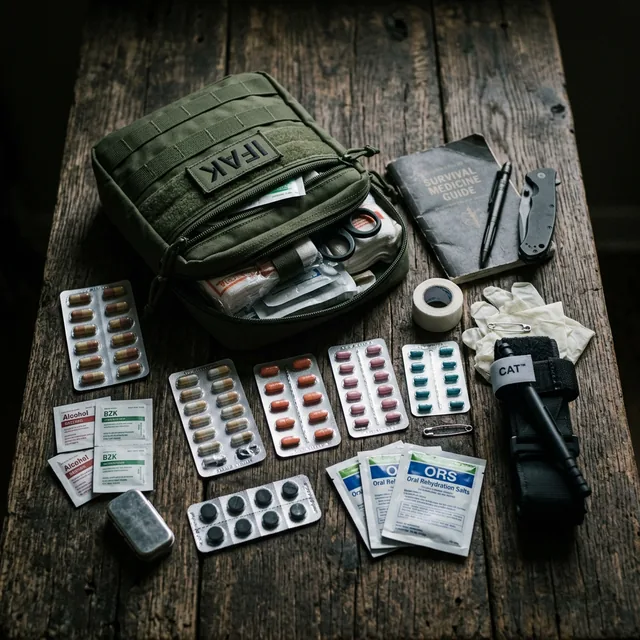
🛡️ Beyond Medication: The Advanced First Aid Kit (IFAK)
While having a detailed list of medications covers internal issues physical trauma requires immediate mechanical intervention. In a survival or emergency scenario your ability to stop a hemorrhage or stabilize a fracture is what keeps a patient alive long enough for those medications to do their work.
An Advanced First Aid Kit (often called an IFAK or Trauma Kit) should be kept alongside your medical stockpile focusing on high-durability life-saving gear.
Essential Items for an Advanced Kit:
Strategic Survival Principles
Medical Reference Guides
Professional medical manuals and algorithms for emergency diagnostic and field treatment.